Every B2B revenue executive knows the grind of the quarterly treadmill.
When your valuation, board standing, and job security hinge on unpredictable, eight-month enterprise sales cycles, the pressure isn’t just professional—it’s deeply biological.
When complex buying committees suddenly freeze budgets or a macroeconomic shift kills a highly lucrative deal, your brain stops treating business as a strategic puzzle. It begins treating it as an existential threat.
Without realizing it, senior leadership teams regularly slip into a psychological and operational “survival mode.”
The ultimate cost of this state is strategic drift. When an executive team spends 100% of its cognitive energy surviving the next 30 days, nobody is steering the company toward where the market will be in two years. This opens the door wide for calmer, more agile competitors to disrupt the space.
There’s a persistent myth in executive culture that choices are made through pure logic and intellect.
You create elaborate spreadsheets, demand deeper attribution models, and call emergency strategy sessions. It’s convenient to assume that under intense pressure, your mind sharpens and distills complex variables into clean, objective choices.
But your nervous system registers a threat before your mind can even process what’s actually happening. What feels like a rigorous strategic pivot in the heat of the moment is often simply a dysregulated system trying to feel safe again.
If you don’t catch this happening in real time, your personal stress responses get mistranslated as a viable strategy. Over time, those reactions harden into the culture, workflows, and operational architecture of the business.
To maintain clarity, authority, and decision velocity when growth is on the line, you must first identify how your inner state is shaping the way you interpret and respond to these growth constraints.
Here are the five default executive threat responses that rewire your enterprise architecture when under pressure.
The Five Physiological Modes of Executive Friction
The “Fight” Response: Hyper-Fixation and Micromanagement
When leaders feel a loss of control, the default reaction is often to grab the nearest steering wheel—even if someone capable is already driving.
- Deal-Level Meddling: Executives bypass their VPs and directors to directly manage individual sales conversations. Instead of fixing macro pipeline conversion bottlenecks, they spend hours over-analyzing minor details of a single pipeline opportunity instead of focusing on macro strategy.
- The Systemic Damage: To soothe anxiety, leadership implements daily forecast calls or erratic Slack check-ins. This pulls AEs away from actual selling to generate defensive reporting that proves they are working, effectively taxing the revenue engine.
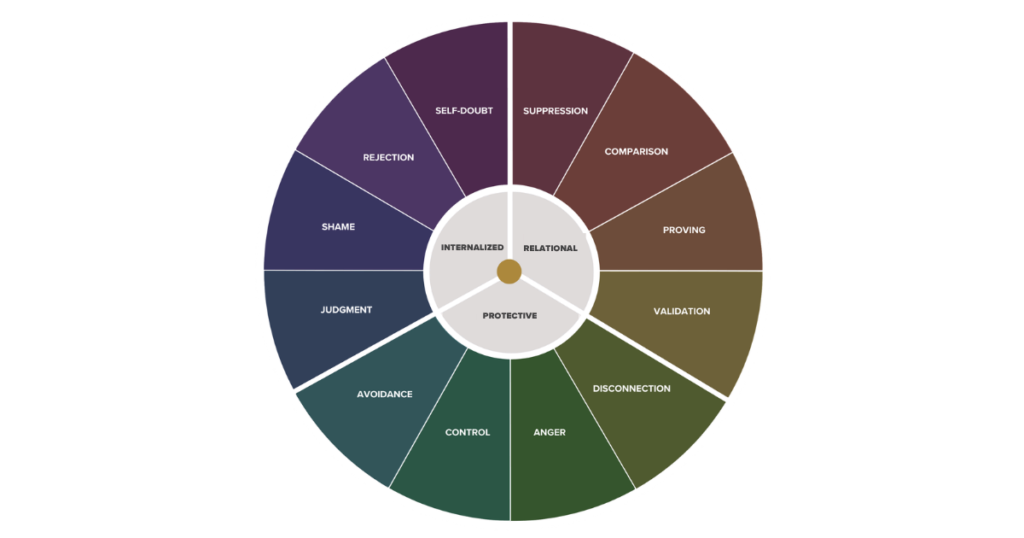
See Pressure Patterns: Proving, Control, Judgment
The “Flight” Response: Short-Termism and Panic Selling
When survival mode prioritizes hitting this Friday’s deadline over next year’s health, long-term value is sacrificed for immediate cash.
- Destroying Future Margins: Panicked leaders heavily discount enterprise contracts just to pull revenue into the current quarter, destroying renewal margins and anchoring the brand’s value lower.
- The Systemic Damage: Instead of building a sustainable pipeline, executives aggressively upsell current customers. This short-term cash injection risks severe churn and damages long-term account relationships.
See Pressure Patterns: Avoidance, Disconnection
The “Freeze” Response: Risk Aversion and Analysis Paralysis
When the fear of making a mistake outweighs the desire to innovate, organizations stall out. Leaders begin choosing the historically safe option over the right option.
- Reverting to Outdated Playbooks: To protect their position, executives kill innovative, yet unproven go-to-market strategies or marketing experiments. When facing a declining pipeline, they demand a return to “what we’ve always done,” even if the market has fundamentally shifted and none of those initiatives have yielded ROI in the past three quarters.
- The Systemic Damage: Decisions require endless data, external reports, and cross-functional committees. This delayed decision-making destroys organizational momentum because no single leader wants to carry the blame for a failed bet.
See Pressure Patterns: Suppression, Comparison, Self-Doubt
The “Fawn” Response: Board-Pleasing and Over-Commitment
Fawning manifests as an intense desire to appease authority figures and avoid conflict, usually at the expense of reality and operational capacity.
- Abdicating Authority: Revenue executives nod along to unrealistic, top-down board targets during a downturn, completely ignoring the data from their data analytics team. They accept a growth mandate without asking for the corresponding budget or headcount required to achieve it.
- The Systemic Damage: The executive over-promises to the board and then forces their teams to artificially inflate pipeline numbers (“commit” stages) to maintain the illusion of success. This creates an environment of collective denial where data is manipulated rather than analyzed, and political shields get built to survive the next board meeting.
See Pressure Patterns: Validation, Shame, Rejection
The Defensive Response: Tribalism and Blame-Shifting
When revenue drops and survival mode dictates finding a scapegoat, internal trust evaporates and organizational silos harden.
- The Silo Wars: Instead of diagnosing systemic issues, departments point fingers. Product gets blamed for a lack of features; Marketing gets blamed for poor lead quality; Sales gets blamed for bad execution.
- The Systemic Damage: Teams are pressured to artificially inflate pipeline numbers to appease the board. This creates an environment of collective denial where data is manipulated rather than analyzed. Cross-functional collaboration breaks down entirely, and energy is redirected away from actually solving market constraints.
See Pressure Pattern: Anger
The Blueprint: How to Reclaim Decision Velocity
Breaking corporate survival mode requires looking past standard GTM playbooks. You cannot solve a psychological and somatic constraint with a new software tool or a dashboard. True revenue resilience starts by shifting your internal state so you can see your growth constraints clearly, and actively break the cycle of reactionary response.
For Sales Leaders (CRO, VP/SVP Sales)
- The Survival Trap: Defaulting to “Fight” (micromanaging deals) or “Flight” (panic discounting).
- The Shift: Practice somatic pausing before forecast calls. When the urge to meddle arises, deliberately step back and reallocate that cognitive energy into protecting your team’s selling time. Shift your focus from micro-managing deals to macro-level enablement and removing friction.
For Marketing Leaders (CMO, VP/SVP Marketing)
- The Survival Trap: Defaulting to “Freeze” (sticking to broken, safe playbooks) or “Defense” (viewing lead volume and quality pushback as a personal attack).
- The Shift: Own the reality of the pipeline numbers without defensiveness. Integrate the “shadow” fear of failure by running micro-experiments. Allocate 10% of the budget to unproven, high-upside GTM plays, defining “success” purely by what the team learns rather than instant revenue.
For Growth & Strategy Leaders (VP/SVP Growth, Head of Growth)
- The Survival Trap: Defaulting to “Fawn” (agreeing to impossible data targets) or “Flight” (pushing short-term features that cause technical debt).
- The Shift: Maintain your authority by grounding your strategy in objective data reality. When the board pressures you for unachievable metrics, present clear trade-off models rather than blind compliance. Protect decision velocity by forcing clear, binary choices on product/market experiments.
The Most Critical Revenue Infrastructure is the Inner Architecture
When growth is on the line, the most critical infrastructure in your organization is your executive team’s internal state, not your tech stack or your data model. If your leadership team is operating on a frantic, 30-day cognitive horizon, you aren’t scaling; you are just surviving.
Breaking this cycle requires recognizing these behaviors not as leadership failures, but as predictable stress responses. True revenue resilience starts by shifting the internal culture from frantic threat mitigation back to calm, long-term execution.
Ready to stop reacting to pressure and start engineering clarity? Let’s identify the hidden default patterns that are driving your GTM strategy. Book a Decision Velocity Session to reclaim your authority and accelerate your strategic execution.