As a senior B2B revenue leader, you are never just managing numbers, pipeline models, or headcount.
You are managing an energetic ecosystem.
Because of the sheer weight of your authority, your internal state acts as an unspoken, highly conductive current that runs through your entire organization. When you walk into a room or join a Zoom call carrying unacknowledged panic from a dropped metric, or the residue of a bruising board meeting, you aren’t just feeling that stress in isolation. You are generating a Projection Field.
We heavily underestimate this ripple effect. We focus on the literal words an executive speaks, ignoring the somatic frequency underneath.
But your team’s nervous systems are finely tuned to your equilibrium. If your inner state is a frantic loop of threat mitigation, your organization will subconsciously reshape its entire behavior just to survive you.
How Teams Absorb the Stress
When a leader chronically operates from a state of fear or panic, that anxiety has to go somewhere. If it isn’t consciously held and integrated internally, it gets projected outward onto the GTM engine.
The organization instantly mirrors the leader’s internal tension:
The Hiding of the Reality (The Shielding Response)
When a team senses that their leader is somatically fragile or reactive under pressure, psychological safety evaporates. People stop bringing hard truths to the table. Unfavorable news is softened, slipping timelines are glossed over, and red flags on major enterprise accounts are intentionally hidden. The team implicitly decides: “Our leader cannot handle the weight of this reality right now, so we must protect them—and ourselves—from their reaction.”
Activity Without Progress (The Performative Sprint)
When an executive is locked in a frantic “Fight or Flight” state, they project a constant demand for urgency. The team internalizes this as a need to look incredibly busy to prove their worth. They spin up endless internal projects, generate massive slide decks, and schedule back-to-back alignment calls. The engine revs violently in neutral, burning immense cognitive energy on defensive corporate theater instead of deep, calm market execution.
Strategic Timidity (The Ghost Pipeline)
If a revenue leader’s projection field communicates that mistakes are terminal, the team intentionally plays small. Account executives stop swinging for the complex, creative deals that require unconventional structuring. Marketing teams refuse to experiment with bold positioning. The entire enterprise defaults to a low-stakes, low-exposure baseline because the organizational nervous system has been trained to prioritize conflict avoidance over breakthrough growth.
Observing Your Projection Field
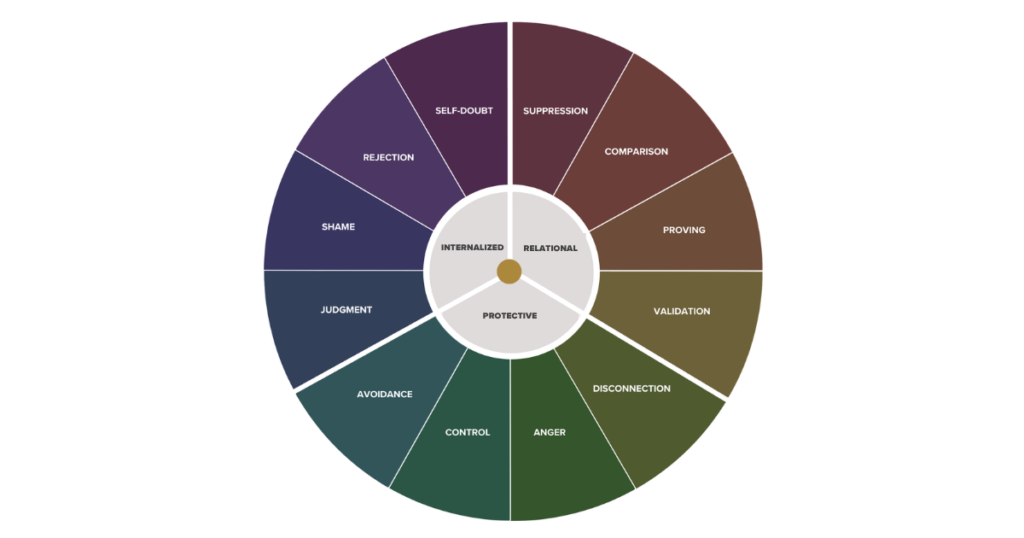
When a revenue leader integrates advanced technology from a pattern of control, proving, comparison, or rejection the Look closely at the downstream effects of your current executive presence. Which ecosystem are you currently cultivating?
| When You Broadcast: Projected Panic (Threat State) | The Team Responds With: Defensive Distortion |
| Hyper-vigilance & control | Data hoarding, vanity metrics, and hidden pipelines. |
| Frantic, low-grade urgency | Burnout, performative busyness, and cognitive fatigue. |
| Blame-shifting & scapegoating | The “Silo Wars” (Sales vs. Marketing vs. Product). |
| Unrealistic, unbacked compliance | False consensus, hidden resistance, and execution drag. |
| When You Broadcast: Regulated Authority (Sovereign State) | The Team Responds With: Decision Velocity |
| Grounded somatic calmness | Radical data transparency and immediate red-flag triaging. |
| Spacious, strategic focus | High-leverage execution and creative deal structuring. |
| Clinical, non-judgmental curiosity | Deep cross-functional alignment and collaborative ownership. |
| Clear, data-driven boundaries | Strategic alignment, psychological safety, and rapid execution. |
The Executive Blind Spot: Solving the Symptom, Missing the Source
The ultimate tragedy of the projection field is that leaders routinely misdiagnose the resulting chaos.
When a CRO or an SVP sees their pipeline stall, data being obscured, or execution grinding to a halt, their default response is to double down on external pressure. They implement more rigid management frameworks, mandate stricter CRM tracking, or issue top-down ultimatums.
They try to fix a systemic cultural symptom while entirely ignoring the fact that their own unexamined anxiety created the constraint in the first place. You cannot audit or optimize a team out of a fear state that you are actively projecting into the room.
Reclaiming the Field
Shifting a team from defensive survival back into aggressive clarity requires an intense act of leadership sovereignty. You must deliberately dismantle your own projection field before you can expect your organization’s execution to change.
1. Own the Atmosphere:
Before you step into a high-stakes pipeline review or a cross-functional strategy session, run a rigorous internal diagnostic. Ask yourself: What energy am I bringing into this space? Am I looking for structural solutions, or am I looking for a place to offload my ambient anxiety? If you are tight, reactive, or defensive, explicitly acknowledge it to yourself — without judgment or shaming — so you don’t inadvertently bleed it onto your directors.
A 60-Second Ritual: Take a minute to track your internal metrics. Close your eyes and take a deep inhale into your lower abdomen. As you exhale, lower your shoulders and unclench your jaw. Tilt your head toward your right shoulder. Then to the left. Vigorously shake your hands to discharge any residue from previous meetings. Step into your next call or interaction only when your internal baseline feels settled.
2. Differentiate Urgency from Panic
There is a profound difference between crisp, high-velocity execution and frantic, low-grade panic. Urgency is grounded, strategic, and focused on clear binary choices. Panic is scattered, emotional, and relies on hyper-vigilance. When demanding speed from your team, ensure your physical delivery is calm and spacious. If your voice and posture communicate safety, your team can access the drive and autonomy needed to actually move fast.
3. Establish a “Radical Truth” Protocol
To break the echo chamber of your own projection field, you must actively reward the friction of reality. When a director or VP brings you troubling data such as a pushed enterprise closing date or a failed marketing campaign, pause before responding. Take a moment to acknowledge your default stress response and consciously override it. Thank your team for the clarity, praise them for their honesty, and ask them for solutions. By remaining neutral and regulated in the face of adversity, you communicate that the truth is safe, and you neutralize the need for defensive distortions.
Interrupting the Invisible Ripple
Your organization will never be calmer, more strategic, or more agile than its executive leadership team. The invisible ripple of your internal state will always override your documented strategy, your playbooks, and your corporate value statements.
When you master your inner architecture, you stop broadcasting panic and start radiating deep, unshakeable authority. You create a clean projection field—a spacious environment where data is clear, decisions are swift, and your team has the psychological safety required to execute with maximum velocity.
Ready to sharpen the lens through which your organization operates? Let’s identify the unspoken currents shaping your corporate culture. Book a Decision Velocity Session to regulate your leadership presence, reclaim your authority, and accelerate your strategic execution.