Everywhere you look, enterprise leadership teams are moving at lightning speed to adopt artificial intelligence.
Job descriptions are stuffed with AI-native language, go-to-market teams are frantically repositioning themselves as “AI-first,” and boards are demanding immediate efficiency metrics.
Yet, the vast majority of B2B enterprises will not see the massive returns on investment they expect.
This is not a criticism of the technology because it is extraordinarily capable. But technology is never a cure for structural confusion; it is an accelerant of whatever psychological and operational conditions already exist beneath it.
I witnessed this exact dynamic unfold during the golden age of marketing automation in the late 2000s. As part of an implementation team onboarding a major enterprise tech tool, we genuinely believed the software would instantly cure our fragmented data, eliminate manual tracking, and fix a messy sales handoff. It was a lovely dream that came crashing down the moment we realized our internal architecture wasn’t structurally prepared to support the technology.
What should have been a three-week implementation ballooned into three months of friction. While our tech stack had evolved, our leadership’s baseline beliefs about the way growth functioned had not.
Marketing automation did not fail the companies that adopted it. It simply revealed, faster and at a much larger scale, when the underlying system was incoherent.
Today, we are seeing the exact same pattern repeat with AI. But this time, it is occurring with significantly greater velocity, because the technology is more autonomous and the cultural pressure to conform is far more intense.
AI as a Diagnostic Event for Executive Operating States
AI is an amplifier. It amplifies structural clarity where clarity already exists, compressing timelines and freeing human capacity for high-order strategy.
AI will not fix existing executive bottlenecks. It will simply produce more volume, more output, and more activity with none of the strategic resonance that was missing in the first place. The output will become faster, and the internal disconnection will become louder.
Most of the intense pressure leaders feel to force an immediate, top-down AI mandate is not emerging from a clear-eyed assessment of business needs. It is being absorbed from the ambient anxiety of the broader market.
The Somatic Pace of the Modern Enterprise
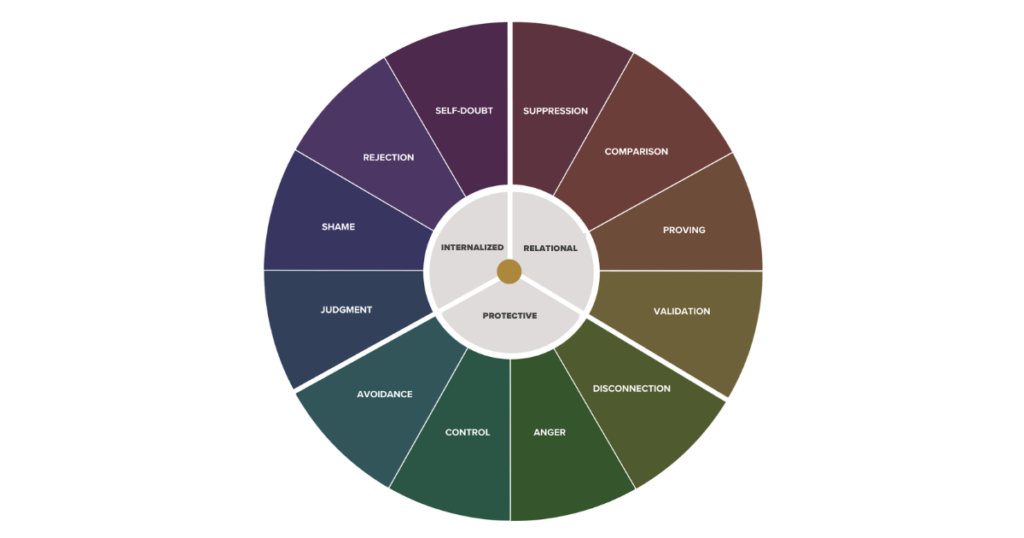
When a revenue leader integrates advanced technology from a pattern of control, proving, comparison, or rejection the technology reproduces those exact patterns at scale:
- Automated Micromanagement: A leader locked in a need for control uses AI to flood dashboards with thousands of granular, automated metrics. This creates defensive corporate reporting loops that overwhelm managers and pull them away from actual market execution.
- The Activity Treadmill: A panicked go-to-market team uses generative tools to rapidly produce massive volumes of generic content and outreach. This floods the market with strategically empty noise, burning through prospect goodwill and damaging brand equity.
- Compliance Over Discernment: Executives blindly agree to aggressive, AI-driven efficiency targets demanded by the board without auditing whether their team possesses the capacity or judgment required to manage the tools effectively.
This is where technology intersects directly with executive physiology. AI accelerates the pace at which decisions are made and executed. Consequently, it accelerates the speed at which a dysregulated leadership team acts on reactive impulses.
A leadership team operating from panic or chronic urgency will naturally use AI to compress organizational timelines past the breaking point, which will strip the organization of its grounding. Conversely, a team operating from a regulated baseline can use AI as a clarifying instrument by leveraging its speed to preserve their own cognitive margin.
Pace is no longer just an operational metric; it is an executive variable.
Restoring Strategic Discernment
Resisting the market urgency narrative requires stepping out of corporate threat response and conducting a clean assessment of your operational state:
- Audit the Baseline First: Before mandating AI integration across workflows, isolate where operational friction already lives. If your market positioning is fractured, AI will simply generate high volumes of articulate noise for an audience that doesn’t care. Foundational strategic alignment must precede technological speed.
- Elevate Executive Judgment Over Velocity: Output that appears fluent is not the same as strategy that is commercially resonant. The highest-leverage investment a revenue leader can make today is not in prompt libraries, but in cultivating team discernment, taste, and critical analysis—capacities that cannot be automated.
- Decouple Adoption from Defensive Survival: Recognize when the pressure to become “AI-native” is being absorbed passively from market anxiety rather than driven by clear commercial logic.
The Arrival of AI is Inherently Disruptive
It strips away the luxury of slow execution, revealing the exact state of your organization and your leadership. Companies with coherent strategy become exponentially more effective. Companies with hidden internal incoherence become visibly strained.
AI tools can make average work cheap and instantaneous, which means the market is starved for distinctive, deeply human capabilities, such as embodied presence, relational intelligence, creative synthesis, and clear strategic positioning.
The primary question facing revenue leaders today is not how fast they can roll out the next tool, but whether they possess the internal clarity required to command the velocity they are about to unleash.
Ready to stop reacting to the market’s urgency and start leading with true authority? Let’s evaluate the hidden default patterns and structural stress points shaping your go-to-market strategy. Book a Decision Velocity Session to align your internal architecture, and accelerate your strategic execution.